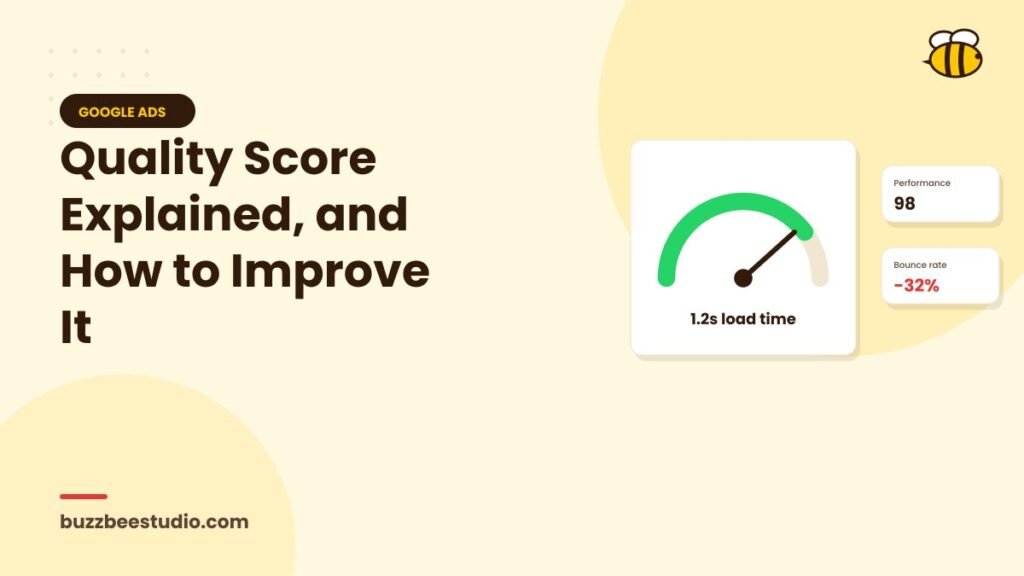
Quality Score is Google's rating of how relevant and useful your ads, keywords and landing pages are compared with other advertisers. It's shown on a scale from 1 to 10 at the keyword level. A higher Quality Score generally means your ads are more relevant, which can help you achieve better positions and lower costs.
What Quality Score measures
Quality Score is based on three components, each rated as "Above average", "Average" or "Below average":
Expected click-through rate
How likely your ad is to be clicked when shown for that keyword, compared with other advertisers.
Ad relevance
How closely your ad matches the intent behind the keyword.
Landing page experience
How relevant and useful your landing page is to people who click your ad, including content, ease of use and speed.
Why Quality Score matters
Quality Score itself isn't used directly in the auction; it's a diagnostic tool. But the factors behind it are part of how Google calculates Ad Rank in real time. Improving relevance, expected click-through rate and landing page experience can:
- Help your ads appear in higher positions.
- Reduce cost per click.
- Increase conversion rates.
How to check Quality Score
In Google Ads, go to your keywords view and add the Quality Score columns, including the three components. Look for keywords with low scores and identify which component is weakest.
Improving expected click-through rate
- Write compelling ads: include benefits, offers and differentiators.
- Include keywords in headlines where natural.
- Use assets: sitelinks, callouts, structured snippets and images make ads more prominent.
- Test different messages: add new headlines and descriptions, and replace weak ones.
- Target the right searches: remove irrelevant keywords and add negatives.
- Use ad scheduling and location targeting to show ads when and where people are most likely to engage.
Improving ad relevance
- Create tightly themed ad groups: each ad group should focus on one service or closely related keywords.
- Match ad copy to keywords: if the keyword is "emergency plumber Dubai", your ad should mention emergency plumbing in Dubai.
- Split broad ad groups: separate unrelated keywords into their own ad groups.
- Review search terms and adjust keywords and negatives.
Improving landing page experience
- Match the message: the landing page should deliver what the ad promises.
- Use relevant content: clearly describe the service with detail.
- Make it fast: optimise images and scripts.
- Make it mobile-friendly.
- Make it easy to act: visible contact options and short forms.
- Build trust: reviews, credentials, clear policies and contact information.
- Avoid intrusive pop-ups.
Use dedicated landing pages for each main service rather than sending all traffic to your homepage.
Don't chase the number blindly
Quality Score is a helpful indicator, but your real goal is profitable conversions. A keyword with a modest Quality Score that brings profitable customers may be worth keeping, while a keyword with a high score that never converts may not be. Use Quality Score to diagnose problems, not as the only measure of success.
Quality Score for new keywords
New keywords start with limited data. Scores may change as Google gathers impressions. Give new keywords time before drawing conclusions.
Quality Score and Smart Bidding
With automated bidding, Google adjusts bids in real time based on many signals. Relevance and landing page quality still matter, because they affect how often you win auctions and how much you pay.
A simple improvement routine
- Each month, review keywords with significant spend and low Quality Scores.
- Identify the weakest component.
- Fix it: restructure ad groups, improve ads or upgrade landing pages.
- Monitor changes over the following weeks.
An example
Imagine an ad group for "water heater repair" sending traffic to a general plumbing homepage. Expected CTR might be average, ad relevance average and landing page experience below average. By creating a dedicated water heater repair page that loads quickly, mentions the service clearly, shows prices and reviews and has a WhatsApp button, the landing page component often improves. Writing ads that mention water heater repair specifically can lift ad relevance and click-through rate too. Small fixes like these often add up.
Final thoughts
Quality Score reflects how well your ads meet searchers' needs. Focus on tight ad groups, relevant ads and helpful, fast landing pages. You'll improve Quality Score along the way, and more importantly, you'll get better results for the same budget.
Buzz Bee Studio audits Google Ads accounts for relevance and landing page quality. Get in touch for a free Quality Score review.